Posted On: September 08, 2026
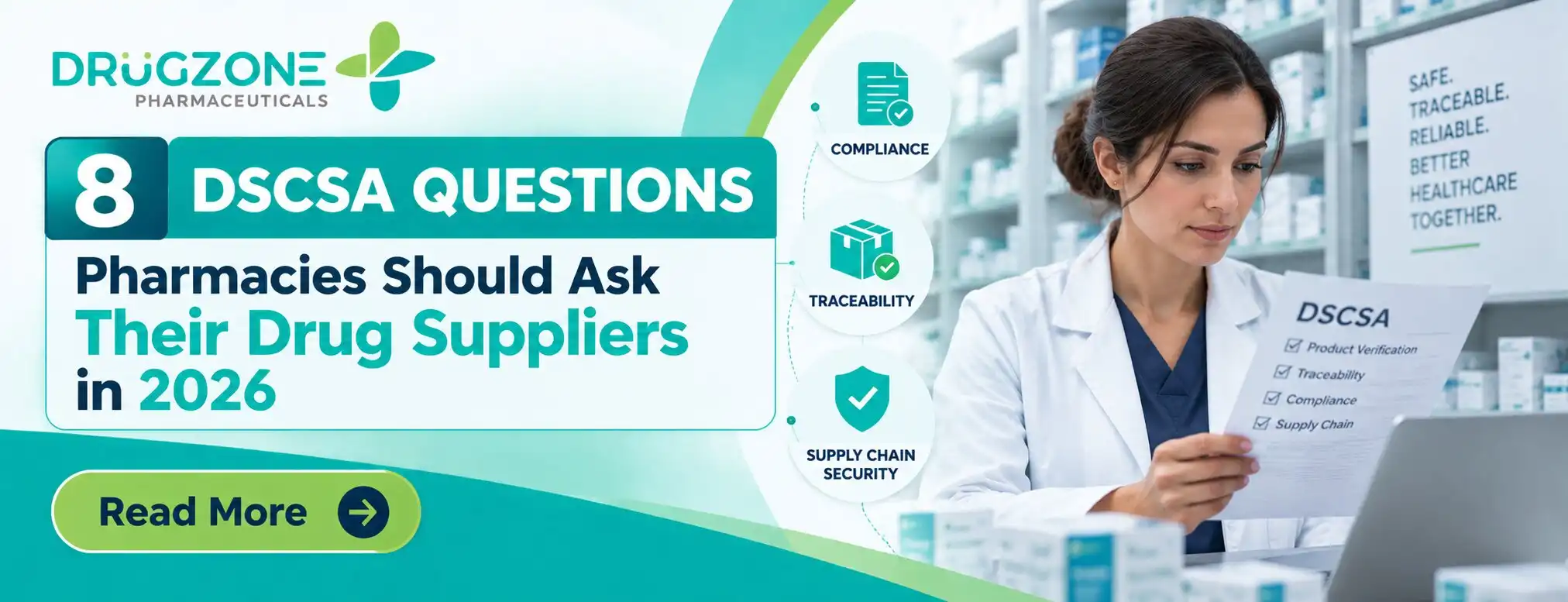
8 DSCSA Questions Pharmacies Should Ask Their Drug Suppliers in 2026
DSCSA compliance is no longer optional. In 2026, the pharmaceutical supply chain runs on electronic, package-level traceability. For pharmacies, that raises the stakes on one decision: which wholesale pharmaceutical companies you buy from. The right supplier keeps you compliant. The wrong one exposes you to refused returns, failed audits, and supply gaps.
The timing matters too. Large dispensers have been under the enhanced rules since late 2025. Small dispensers have until November 27, 2026. Either way, your suppliers' DSCSA readiness is now your concern as well.
Here is the shift that changes everything for pharmacies. Under DSCSA, compliance is no longer something your supplier handles alone. You share it. When you evaluate wholesale pharmaceutical companies today, you are really evaluating how much risk each one removes from your own operation.
Below are eight DSCSA questions every pharmacy should ask wholesale pharmaceutical companies before signing or renewing an account. Each one targets a specific compliance risk. The answers reveal quickly whether a supplier is a safe partner.
Why your supplier choice drives DSCSA compliance in 2026
The Drug Supply Chain Security Act (DSCSA) was signed into law in 2013. It builds a national system to trace prescription drugs. It also helps catch suspect, diverted, or counterfeit product before it reaches a patient. After a staggered rollout, the enhanced requirements are now in force across most of the supply chain.
Wholesale distributors have operated under the DSCSA enhanced requirements since August 27, 2025, and large dispensers since November 27, 2025. Small dispensers, those with 25 or fewer licensed pharmacists or technicians, have until November 27, 2026. (Source: U.S. Food and Drug Administration)
Your suppliers sit upstream of your pharmacy. If their data, licensing, or product identifiers fall short, your compliance falls short too. That is why vetting wholesale pharmaceutical companies on DSCSA is now essential. Among wholesale pharmaceuticals USA suppliers, the compliant ones treat these obligations as routine.
The enhanced requirements come down to a few essentials. Transact only with authorized trading partners. Handle only product that carries a valid identifier. Exchange transaction data electronically at the package level. Each of the questions below maps to one of these duties. Ask them early, because switching suppliers after a compliance problem is far harder than vetting wholesale pharmaceutical companies up front.
State oversight raises the stakes further. Several state boards of pharmacy now check DSCSA readiness at license renewal. A gap that starts with a supplier can end up on your record. Choosing carefully among wholesale pharmaceutical companies is therefore a way to protect your license, not just your inventory.
8 DSCSA questions to ask wholesale pharmaceutical companies
Work through these questions in order. Together they cover licensing, data, product identity, and the day-to-day events that trip pharmacies up. Ask them of every candidate, and compare the answers side by side. The most compliant wholesale pharmaceutical companies will welcome the scrutiny, because their processes hold up under it.
1. Are you an authorized and licensed trading partner?
DSCSA lets you buy only from authorized trading partners. Start here. Ask for current state wholesale distribution licenses for every state that ships to you. Confirm each one with the state board of pharmacy.
Accreditation adds assurance. Look for NABP Drug Distributor Accreditation at the shipping facility. Reputable wholesale pharmaceutical companies share this proof without hesitation.
Why does this matter so much? DSCSA makes trading-partner status a legal requirement, not a nicety. If you buy from an unlicensed or unauthorized source, you fall out of compliance the moment that product enters your pharmacy. Ask for documentation in writing, and keep it on file. The strongest wholesale pharmaceutical companies maintain licensure in every state they serve and can prove it on request.
2. How do you send transaction information and transaction statements?
The enhanced rules require electronic, package-level data. Ask how the supplier sends transaction information (TI) and transaction statements (TS). The answer should involve an interoperable electronic system, usually built on the EPCIS standard.
- Data sent electronically, not on paper
- Package-level detail with unique product identifiers
- A format your pharmacy system can receive and store
Interoperability is the whole point. Your system and the supplier's must speak the same language, so data flows without manual re-keying. Ask whether the supplier has already connected with pharmacies like yours, and how long onboarding takes. A partner that has done this many times will make your setup far smoother. Confirm that you can pull historical transaction data later, when an auditor or investigator asks for it.
3. Do all products carry a valid product identifier?
Every package should carry a valid product identifier. That includes a 2D barcode with the product's serial number. Ask whether the supplier ships only serialized, scannable product. A package you cannot scan and match creates problems for every partner downstream.
Verification at receipt is where many pharmacies stumble. Under the enhanced rules, you are expected to confirm product identifiers when product arrives. Ask whether the supplier's packaging supports quick scanning, and how it resolves identifier mismatches. Wholesale pharmaceutical companies that invest in clean, accurate labeling save you time at the receiving dock and reduce rejected product.
4. How do you handle suspect and illegitimate product?
Ask how the supplier identifies, quarantines, and investigates suspect product. A strong answer includes prompt notification and FDA reporting where required. It also includes a clear paper trail. This is how counterfeit or diverted product gets stopped early.
Timing is part of compliance here. When illegitimate product is found, trading partners must act quickly. They quarantine the product, investigate, and notify the FDA and affected partners where required. Ask the supplier to walk you through a recent example. A vague answer is a warning sign. A precise, documented process is exactly what you want from any company you trust with patient-bound product.
5. How do you manage saleable returns?
Saleable returns are a common failure point. Distributors must verify returns against the original transaction data. If a return cannot be matched, it may be refused. Ask how the supplier handles returns. Confirm exactly what you must send to avoid a rejected credit.
These refusals are happening now, even before the small-dispenser deadline. If your return does not carry matching transaction data, the credit can be denied, and you absorb the loss. Ask the supplier for a simple, written returns procedure. If you handle 340B product, confirm how the supplier coordinates returns between the covered entity and the contract pharmacy, since that adds another layer.
6. What records will you provide, and for how long?
DSCSA requires trading partners to keep transaction data for six years. Ask how the supplier delivers records you can retain. Confirm you will receive TI and TS in a durable, retrievable format. Good wholesale pharmaceutical companies make recordkeeping simple.
Records are your defense in an audit. If an inspector asks how a product reached your shelf, you must produce the transaction history. Ask where the data lives, how you retrieve it, and whether it stays available if you ever switch suppliers. Companies that give you self-service access to your own records make compliance far less stressful.
7. How fast can you support a trace or recall request?
When a recall or investigation hits, speed matters. Ask how quickly the supplier can trace a product and notify you. Confirm the recall communication process in writing. A slow supplier becomes your compliance liability.
Recalls move fast, and so should your supplier. Ask about notification methods, how affected lots are identified, and how returns or replacements are handled. Confirm you will hear about a recall directly, not discover it secondhand. A supplier that communicates clearly during a recall protects both your patients and your standing with regulators.
It also helps to know the shape of a recall in advance. Ask whether the supplier distinguishes urgent, high-risk recalls from lower-risk ones, and how notification speed differs between them. Clear expectations here mean fewer surprises when a real recall lands on a busy day.
8. How will you help us prepare for the 2026 deadline?
Small dispensers face the November 27, 2026 deadline. Ask how the supplier supports your readiness. Look for onboarding help, system-connection support, and plain-language guidance. The strongest wholesale pharmaceutical companies act as partners, not just vendors.
The pharmacies having the easiest time are the ones that tested their systems months before the deadline, not days before it. Ask what support the supplier offers during that ramp-up, from data-connection testing to staff education. Among wholesale pharmaceuticals USA suppliers, the ones that lead with education and support are the ones worth keeping for the long term.
Your DSCSA supplier checklist
Use this quick checklist when you compare wholesale pharmaceutical companies:
- Authorized trading partner with current state licenses
- NABP Drug Distributor Accreditation at the shipping facility
- Electronic TI and TS at the package level, via EPCIS
- Serialized product with valid identifiers on every package
- Clear suspect-product and recall processes
- Saleable-returns verification you can rely on
- Six-year record retention you can access
- Onboarding support for the 2026 deadline
Score each candidate against this list. A supplier that checks every box is one that helps you sleep at night. The wholesale pharmaceutical companies that fall short on even one line deserve a hard second look before you commit.
Frequently asked questions
What is the DSCSA deadline for pharmacies in 2026?
Small dispensers, those with 25 or fewer licensed pharmacists or technicians, must meet the enhanced requirements by November 27, 2026. Large dispensers were required to comply by November 27, 2025. The FDA has said the small-dispenser date will not move again.
How do I know if wholesale pharmaceutical companies are DSCSA compliant?
Ask for proof. A compliant supplier shares its licenses, its NABP accreditation, and its method for sending electronic transaction data. Among wholesale pharmaceuticals USA suppliers, the compliant ones offer this readily.
What happens if my supplier is not DSCSA compliant?
You inherit the risk. Non-compliant suppliers can trigger refused returns, failed inspections, and supply disruptions. Several state boards now check DSCSA compliance at license renewal, so the stakes reach your own license.
Written by the Drugzone Compliance & Distribution Team — pharmaceutical distribution and regulatory specialists supporting pharmacies, hospitals, and health systems across the United States. Last reviewed: August 2026.
Choosing a supplier that keeps you compliant
DSCSA compliance in 2026 is a shared responsibility. Your pharmacy is only as compliant as the wholesale pharmaceutical companies you buy from. These eight questions give you a fast, practical way to test any supplier before you commit.
The good news is that vetting is straightforward once you know what to ask. Most wholesale pharmaceutical companies will answer these eight questions readily, and the few that hesitate tell you what you need to know. Treat the answers as evidence, not marketing, and keep the documentation on file.
Drugzone Pharmaceuticals Inc. is a nationally licensed, compliance-led distributor built for this environment. As an NABP-accredited, FDA-registered, and DSCSA-compliant partner licensed across all 50 states, Drugzone supports pharmacies with verified sourcing, electronic traceability, and dedicated account support. Among wholesale pharmaceutical companies, it is designed to make your compliance easier, not harder.
Ready to work with a supplier that keeps you compliant? Speak with our team, or visit www.drugzone.com to get started.
Article Author

Binu .B RPH
President
With more than 20 years of experience in the pharmaceutical wholesale sector, I have Founded and managed several companies, including a pharmaceutical wholesale company, a compounding/retail pharmacy,and many more. As the president of Drugzone Pharmaceuticals Inc., I develop new business and maintain existing business relationships.
Tags
Latest Posts
-
Pharmaceutical Wholesale Agreements: What to Review Before You Sign (Checklist, Not Legal Advice)
-
Top 10 Factors to Consider When Selecting a Pharmaceutical Supplier for Multi-Location Clinics
-
How Pharmaceutical Wholesalers Help Pharmacies Reduce Drug Purchasing Costs
-
Top 10 Essential Pharmaceuticals Independent Pharmacies Should Stock From a Pharmaceutical Wholesale Distributor
-
Top 10 State Licensing Requirements Every Licensed pharmaceutical wholesaler Must Meet
Similar Posts
-
PBM Reform 2026: How the New Rebate Pass-Through Law Affects Distributors
-
The Death of the 'Mega-Warehouse': The Rise of Micro-Distribution Hubs
-
How to Handle "Saleable Returns" Under New FDA Verification Guidelines
-
How to Offset the 15% Pharma Import Tariffs by Sourcing from US-Based Suppliers
-

Top 10 Pharmaceutical Suppliers in the USA for Specialized Oncology Meds